Sunday, February 10, 2013

How complicated can you get with a mere 1000 words?

An article by Jennifer Schuessler in today's New York Times online reports:

"Ever since a British scientist posted his Up-Goer Five text editor online, people have been seeing if they can explain subjects from string theory and evolution to Shakespeare and Tammy Wynette using only the 1,000 most commonly used words in English."

Click here to read more.

Wednesday, October 24, 2012

It Ain't Necessarily Wrong

"Philip Gove and Dwight MacDonald Brawl" (1961) or
"Boxers" (1881) by Theodore Gericault
In the October 24th edition of the New York Times, Janet Maslin reviews David Skinner's new book, The Story of Ain't, in which Skinner "tells how and why Webster’s Third New International Dictionary was so controversial, focusing on its most famous entry."  Click here to read the review and find out about the animosity between Philip Gove, the dictionary's editor, and Dwight MacDonald, its biggest critic.

Wednesday, October 17, 2012

Tannen on Presidentidal Debate Interruptions

"Interrupted Sleep" (1750) by Francois Boucher 
Our old friend Deborah Tannen published an article in The New York Times on October 17th, titled "Would You Please Let Me Finish," that offers some insight into the meaning of all of the interruptions that took place in Tuesday's Presidential debate between President Obama and Mitt Romney.

Here's how the article begins:
“I’m used to being interrupted,” President Obama said Tuesday night in his second debate with Mitt Romney, an event in which each man repeatedly cut in while the other was speaking.


"The debates this year might be most remembered for the frequency (and ferocity) with which the candidates have interrupted each other. Nearly all commenters on the phenomenon seem to assume that it is self-evident when an interruption has occurred and who’s at fault, and that interrupting violates the rules of conversation. But just as conversational styles vary widely by gender, ethnicity, geography, class and age, so do ideas about what constitutes interruptions, and whether and when they are good or bad."

Click here to read the full article.

Thursday, April 26, 2012

Monday, March 26, 2012

Wednesday, March 14, 2012

The Official English Debate Continues

So you've done some research, and you've heard some experts. Now, in the comment box at the bottom of this post, identify what is, in your view, the best reason to support Official English legislation and the best reason to oppose it.  (You don't have to hold both reasons to be valid.)

Thursday, March 8, 2012

Making it Official: A Collective Research Project

Below you will find some of the answers you and your classmates have found to the research questions I posed to you in an earlier e-mail about speakers of other languages in the United States, current laws that govern their rights, and the effect proposals to make English the official language of the country would have on those rights and on the federal budget.  Because several of you submitted similar materials (much of it provided by usenglish.org, a website that promotes efforts to make English the official language of the United States), I have edited and consolidated your work.  (My apologies to those researchers who don't get a name check!)

The Numbers 
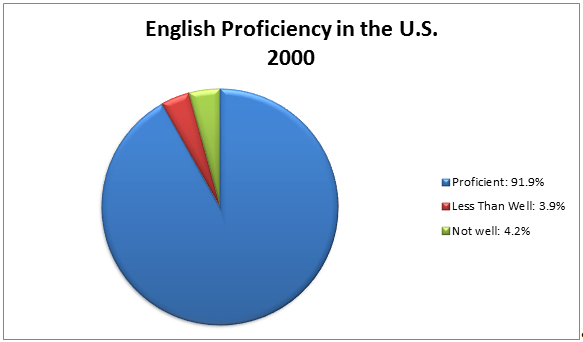
We have read that there are 322 languages spoken in the United States. How do those languages break down in terms of number of speakers? How many people in the United States have limited proficiency in English?


Paula (source: http://www.us-english.org/view/24) reports that in 2000, 8.1 percent of the U.S. population met the definition of limited English proficient set by the U.S. Census, meaning that they spoke English "less than very well." Of these, 4.2 percent spoke English "not well" or "not at all" (Source: Census 2000).